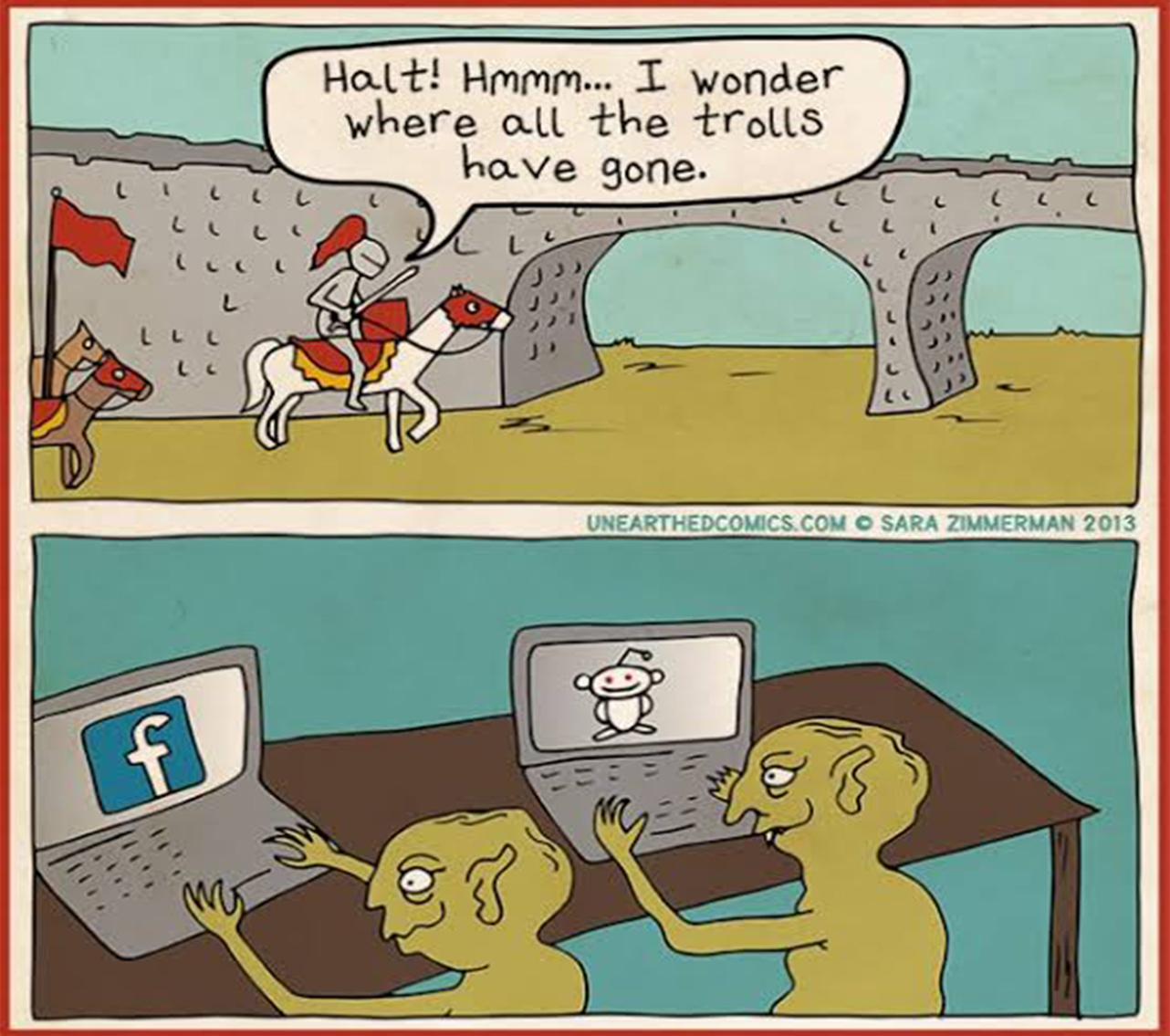
Introduction
The internet has become one of humanity’s greatest inventions. It allows people to communicate across the globe, build businesses, educate themselves, and share ideas instantly. Unfortunately, it has also created an environment where a small minority of individuals devote extraordinary amounts of time to harassment, deception and manipulation. While many people are familiar with the term ‘internet troll’, there exists a far more obsessive category that I refer to as DITs – Demented Internet Trolls.
Unlike the average troll who posts provocative comments for amusement before moving on with their day, DITs appear to build their entire identity around attacking others online. They often create numerous fake accounts, invent fictional personas, impersonate other people, spread misinformation, coordinate harassment campaigns and become consumed by an online fantasy world that bears little resemblance to reality.
For many of these individuals, the internet is no longer a tool—it becomes their entire existence. Hidden behind anonymous usernames and fake profiles, they spend countless hours attempting to influence public opinion, damage reputations, or provoke emotional reactions from complete strangers. Ironically, while believing they hold power over others, they often sacrifice their own careers, relationships and personal wellbeing in pursuit of temporary online attention.
The Psychology Behind the DIT
Psychologists have long recognised that anonymity changes human behaviour.Known as the ‘online disinhibition effect’, people frequently say or do things onlinethat they would never attempt face-to-face. Protected by a keyboard and a fake identity, empathy is reduced while impulsive and aggressive behaviour increases.
DITs take this phenomenon much further.
Many appear to derive satisfaction from creating conflict rather than resolving it. They carefully cultivate anonymous online identities that allow them to become someone they are not. Some maintain dozens of fake social media profiles over many years, creating the illusion that multiple independent people share the same opinions. Others spend thousands of hours researching their chosen targets in an effort to manufacture controversy where little or none exists.
Instead of investing time into careers, hobbies or relationships, their energy is redirected into endless online battles. Their success is measured not by personal achievement but by the emotional reaction they can provoke from someone else.
In many cases this behaviour resembles an addiction. Every response, every angry comment and every viral post provides another dopamine reward that reinforces the behaviour. The more outrage they generate, the more important they feel.
Living Inside a Digital Fantasy
One of the defining characteristics of a DIT is the creation of an alternative digital reality.
Behind fake usernames they become investigators, journalists, whistle-blowers or “truth seekers” despite having no professional training, no accountability and often little understanding of the subjects they discuss. They selectively gather fragments of information that support predetermined conclusions while ignoring anything that contradicts their narrative.
Because their audience often consists of similarly anonymous users, misinformation can circulate rapidly. Rumours become accepted as facts through repetition rather than evidence.
Social media algorithms unintentionally amplify this behaviour. Outrage attracts attention. Attention generates engagement. Engagement generates advertising revenue.
As a result, the loudest and most controversial voices are often rewarded with greater visibility regardless of whether their claims are true.
From Trolling to Blackmail
While many trolls remain annoying but relatively harmless, others escalate into behaviour that crosses ethical – and sometimes legal – boundaries.
One increasingly common tactic is sextortion, where criminals create fake online identities, persuade victims to share intimate images, and then threaten to publish them unless money is paid. Australia’s eSafety Commissioner has warned that organised criminal groups have become highly sophisticated in using these methods, particularly against young men. Victims are often subjected to intense psychological pressure, with some cases resulting in devastating mental health consequences and, in some instances, suicide.
Blackmail, however, is no longer limited to personal relationships.
In the business world, some DITs have discovered that a company’s online reputation can be weaponised just as effectively as private information. Modern consumers often make purchasing decisions based on Google Reviews, Trustpilot ratings and other public review platforms. A handful of damaging reviews – particularly if they appear genuine – can significantly affect a business’s reputation, search rankings and sales.
All review platforms unfortunately do very little in relation to fraudulent reviews, there is no way they can vet these and so the credibility and concept of ‘reviews’ is flawed – the sheer volume of content makes moderation impossible. This creates opportunities for bad actors. Some individuals create multiple fake accounts, use VPNs or disposable email addresses, recruit friends or purchase access to aged online profiles to make coordinated campaigns appear authentic. Others copy legitimate customer language, making fabricated reviews more difficult to detect.
In more extreme cases, review systems have been used as a form of extortion. Businesses around the world have reported receiving threats such as:
“Refund my money or I’ll leave one star reviews everywhere.”
“Pay me to remove the reviews.”
“I’ll keep creating new accounts until your rating is destroyed.”
The mere possibility can place enormous pressure on small businesses whose livelihoods depend heavily on their online reputation. Unlike government agencies who have endless tax payer dollars to inject in counter disinformation campaigns, small businesses simply can’t and don’t want to waste dollars on such campaigns it makes no sense. Why would you want to counter fake reviews with fake reviews?
A particularly malicious tactic involves coordinated review bombing. Rather than one dissatisfied customer expressing an opinion, multiple fake accounts suddenly appear over a short period, posting one-star ratings containing exaggerated, misleading or entirely fabricated allegations. The DITs have of course never even purchased the product or service at all. Their objective is not consumer protection – it is reputational damage.
Another emerging trend involves “reputation-for-hire” schemes. Some unethical operators first damage a business with fake negative reviews before approaching the owner offering paid “reputation management” services to improve or remove the damage they helped create. Others simply sell packages of fake positive reviews to offset fabricated negative ones, creating an artificial marketplace where online trust itself becomes a commodity.
For business owners, proving review fraud can be extremely difficult. Anonymous accounts may disappear as quickly as they appear, while new fake profiles are created just as easily. Even when reviews are eventually removed, the reputational damage, lost revenue and emotional stress may have already taken their toll.
The objective of these campaigns is rarely to help future customers make informed decisions. Instead, they become another tool of intimidation, revenge or attentionseeking – transforming online review systems from a source of consumer feedback into a weapon capable of harming individuals and businesses alike.
Instead, it is attention, control or revenge.
Chasing the Viral Moment
Modern social media rewards sensationalism.
For some DITs, becoming viral for even a few minutes outweighs ethical considerations. A dramatic accusation, misleading edit or carefully constructed conspiracy theory can spread around the world before facts have any opportunity to catch up.
Recent years have also seen the rise of online communities that deliberately manipulate vulnerable individuals for entertainment. Some notorious online groups have been linked to coercion, blackmail, grooming, extortion and organised harassment extending far beyond what most people would consider ordinary trolling. Law enforcement agencies internationally have investigated networks whose activities included exploiting vulnerable teenagers through intimidation and psychological manipulation.
Other examples involve online personalities being deliberately manipulated by anonymous communities into emotional breakdowns simply because viewers found the reactions entertaining. Rather than helping vulnerable people, coordinated groups encouraged increasingly irrational behaviour in order to generate more content and attract more viewers.
These examples demonstrate how online harassment has evolved beyond immature jokes into organised campaigns capable of causing genuine harm.
The Human Cost
The consequences extend far beyond hurt feelings.
Victims frequently report anxiety, depression, sleep disorders, reputational damage, financial loss and withdrawal from public life. Businesses targeted by coordinated trolling campaigns can lose customers despite having done nothing wrong.
History contains tragic examples where prolonged online harassment and blackmail contributed to devastating outcomes. One of the best-known cases is that of Amanda Todd, whose experience highlighted the destructive combination of online blackmail, cyberbullying and relentless harassment.
Many victims simply stop participating online altogether.
Ironically, this means reasonable voices disappear while the loudest extremists become increasingly dominant.
Fighting Back
The most effective response is often not emotional confrontation but evidence, documentation and persistence.
Victims should retain records of harassment, report threatening behaviour to platform operators and, where criminal conduct such as extortion, blackmail or credible threats occurs, notify law enforcement. Australia has strengthened protections against serious online abuse, recognising that anonymous harassment can have real-world consequences.
Equally important is refusing to reward trolls with the attention they seek. Most DITs thrive on reactions. Removing that reward often diminishes their influence.
Technology companies also bear responsibility. Better identity verification, improved moderation systems and faster responses to coordinated harassment campaigns would significantly reduce the ability of serial offenders to create endless fake accounts.
Conclusion
The internet remains one of the greatest tools ever created, but like every powerful invention it can be misused.
If you have young children like I do, keep them away from the social media scene for as long as physically possible, they don’t need to be exposed to this level of poison – ideally forever in their lives.
Ordinary internet trolls seek temporary amusement. DITs—Demented Internet Trolls – represent something more obsessive. They construct false identities, immerse themselves in digital fantasy worlds and devote extraordinary amounts of time attempting to manipulate, intimidate and damage others for personal satisfaction or fleeting online fame.
Fortunately, they remain a tiny minority. The overwhelming majority of internet users simply want to communicate, learn and contribute positively. By recognising the tactics used by DITs, refusing to reward their behaviour, and continuing to strengthen legal and technological safeguards, society can ensure that anonymous harassment does not become the defining feature of the online world.
Ultimately, the greatest victory over a DIT is not winning an argument – it is refusing to allow someone else’s digital fantasy to control your real life.
Written by Paul Tomolowicz, BBA, BEcon
Managing Director – Deep Cycle Systems Aus Pty Ltd